
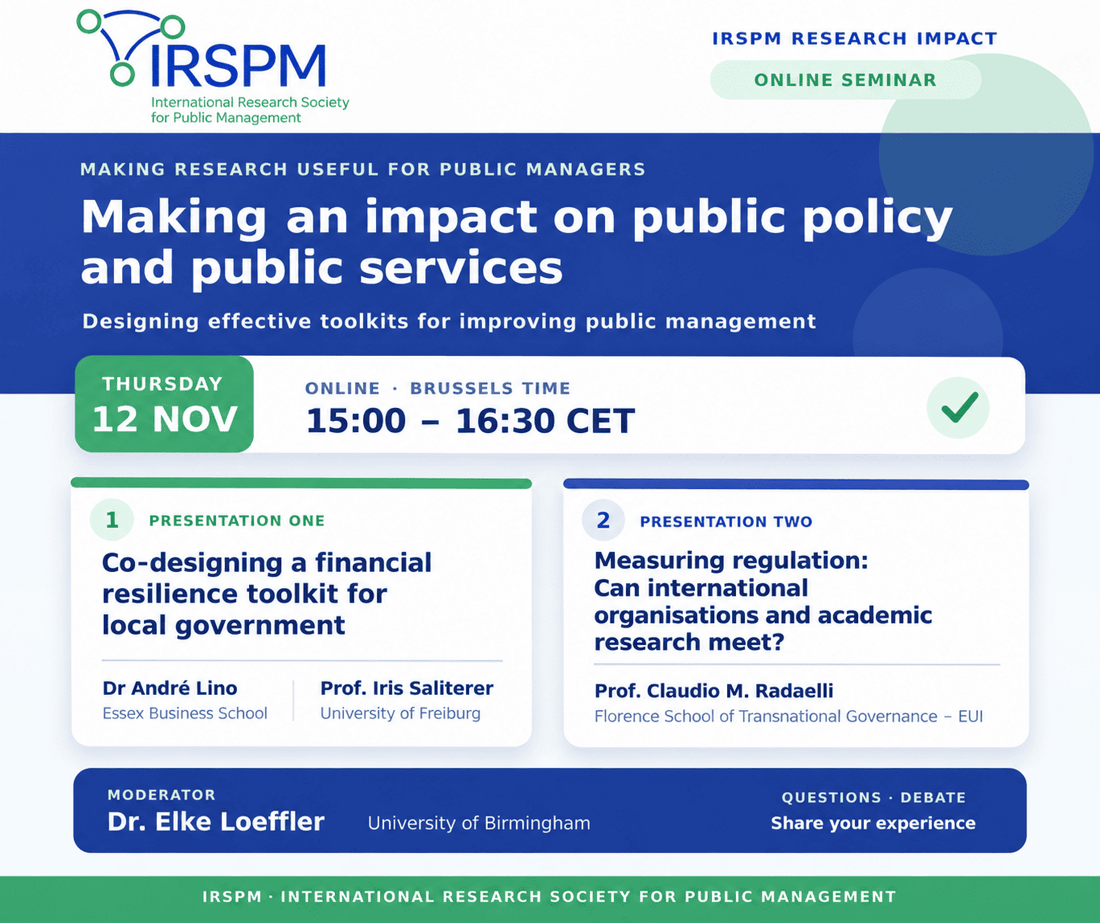
IRSPM Research Impact Online Seminar
This seminar provides two innovative examples of how to make research outputs useable for public managers through toolkits and frameworks for practitioners.
Making an impact on public policy and public services: Designing effective toolkits for improving public management
- Date: Thursday, 12 November
- Time: 15:00 – 16:30 CET (Brussels time)
- Location: Online
- Participation: Free of charge.
- Registartion is required via online form
Dr André Lino, Essex Business School and Prof. Iris Saliterer, University of Freiburg will present a financial resilience toolkit targeted at local government whereas Prof. Claudio M. Radaelli, Florence School of Transnational Governance – EUI, will discuss academic collaboration with the OECD with a focus on measuring regulation.
This comparison will provide insights into two different pathways to the development of impactful research collaboration, exploring how public management toolkits can be co-designed to match the specific needs and skills of specific users. Moreover, we will explore what implementation mechanisms best support the scaling of academic toolkits in a resource-constrained public sector.
After each presentation, there will be opportunities for questions and debate. In the final plenary discussion, participants will be able to feed in their own experiences with the design and implementation of toolkits to improve policies, practice and social outcomes.
Presentation 1
Dr André Lino, Essex Business School and Prof. Iris Saliterer, University of Freiburg: Co-designing a financial resilience toolkit for local government
Presentation 2
Prof. Claudio M. Radaelli, Florence School of Transnational Governance – EUI: Measuring regulation: Can international organisations and academic research meet?
Moderator
Dr. Elke Loeffler, University of Birmingham
Making public management research great again
Prof. Annette Boaz (King’s College London), Prof. Brian Head (The University of Queensland) and Dr. Elke Loeffler (University of Birmingham)
Academics working in public administration, public management and related departments are under multiple pressures. Competition for research funding has made it more difficult and time-consuming to attract research grants, while budget pressures at their university make it harder to do research. At the same time, incentive systems press academics to publish in top academic journals, leaving researchers with little time to network with policy makers and practitioners – who, in turn, often find the theory/methods framing of academic journals difficult to digest or of little use for helping them address current challenges. Fortunately, some journals are beginning to encourage shorter articles in more accessible language to encourage a dialogue with practice. And there is plenty academics can do to mobilise interest in their research beyond producing academic papers.
The disconnects are compounded by other changes, such as the rise of populist leaders, who turn to sources other than academics for confirmatory information and policy advice, such as AI, fake news or social media. Moreover, autocratic leaders in a number of countries attempt to restrict the freedom of expression of academics. However, even in these challenging contexts, public management scholars have options to change how we undertake and communicate research. We need to take seriously these opportunities to increase our impact on policymakers and communities of practice.
Generating innovative policy improvements in relation to wicked problems
We academics have an impressive track-record in undertaking rigorous case-studies and experimental studies on narrow topics. In future, however, we need to find ways to co-design broader research topics and cross-sectoral linkages to address the grand challenges. In particular, we will need to focus more on generating innovative evidence-informed pathways for policy improvements, both for widespread and enduring wicked problems (such as poverty, child protection, and discrimination) and for addressing newly emerging major problems (such as regulating digital platforms and generative AI or responding to novel viruses).
For academics, this will require a greater focus on identifying and testing solution pathways rather than being preoccupied with analysing problems and criticising existing policies. There have been many promising initiatives in this direction – such as the UK What Works Centres and the Wales Centre for Public Policy, to name just a couple.
Consideration of policy solutions cannot be successfully undertaken by researchers alone. Community and practitioner involvement is fundamental in defining the problems, gathering and sharing information, engaging in deliberation about possible solutions, and testing them in practice. In these deliberations, ‘lived experience’ is arguably as important as the findings of RCTs and sophisticated quantitative analysis. For many of our complex and contested issues, this means that relevant knowledge is not confined to ‘rigorous science’. Social researchers will need to grapple with the trade-offs and prioritisation challenges that face policy- and decision-makers.
In consequence, researchers will need to expand their range of skills and capabilities to work with partners. Various forms of ‘design thinking’ and long-term strategy development will require imagination as well as rigorous analytical techniques. Major new projects will need to examine fundamental assumptions about problems and solutions (e.g. through action research and collaborative learning).
Developing and nurturing research networks and partnerships with practitioners and communities
What partnerships and networks have in common is that they put practitioners and communities at the centre of research to enhance the impact of evidence on policy and practice.
One promising approach to achieving a shift in academic practice would be to establish partnerships between policy makers, practitioners and communities. This would mean a move beyond the one-off, bilateral interactions associated with individual research projects to more long-term collaborations. In these partnerships, driven by principles of mutuality, there will be scope for joint setting of research priorities and joint research to meet partner needs. This is a more intensive and productive way of working, with collaboration centring on the relational element of research production and application. One problem with promoting ‘partnerships’ is that we all think we are doing it already, but the reality is that meaningful, mutually beneficial partnerships with complementary objectives are hard to build and even tougher to sustain. They need resourcing and they also need time to develop momentum.
Research networks which spread learning across wider systems may be one way of developing a partnership. Although they are often vulnerable in terms of funding and find it hard to demonstrate impact, networks in our digital age can be run at low cost and can be shaped into more productive partnerships over time.
Making it happen: From evidence-based to research-informed policies and practice
In brief, we argue for shifting the research focus and changing the way we do public management research. What are the prospects of making this happen in our academic communities? First of all, academics need to be more humble and acknowledge that their research is only one source of knowledge and that the tacit knowledge of public managers and staff and the lived experience of communities are also important. One way of enabling more mutual knowledge exchange could be to match researchers working in public administration, public management and related departments with a practitioner ‘buddy’. Such co-mentoring schemes may enable deeper reflection and continuous learning on both sides. Second, our academic events need to be less inward-looking and to engage more with practitioners and communities in order to facilitate dialogue. The question is how to make this happen in times of austerity. Third, we would like to build on Albert Meijer’s plea at a recent IRSPM online forum to move towards ‘slow academia’ - to go for quality and not quantity: This would not only give academics more time for in-depth thinking and reflection but also for more meaningful dialogue with people outside academia.